Jemison Gets Banded
2010 was another banner year at the Rochester Falconcam as our two Peregrine nestlings received their ID bands from the DEC and, even better, got their names! More on that a little later. It also marked the first time that we’ve been able to broadcast the banding live, on the Rochester Falconcam’s Streaming Video page.
It looked like it might rain today, but we had good weather for the banding. Our intended start time of 10AM slipped a little, but that didn’t stop crowds of local falcon fans, television and print media, school children and even some passers-by from turning their eyes to the sky in anticipation of all the banding day action.
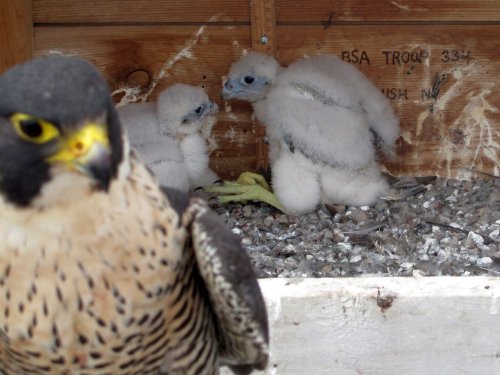
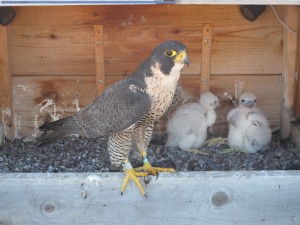
Archer and Beauty put on a spirited defense of the nest box. Beauty wasn’t as aggressive as Mariah. She and Archer stayed 15-20 feet (4-6 meters) away. This being her first year of motherhood, we expect that she won’t give us the same latitude in the future. Both she and Archer contributed equally to defending their young, with plenty of kacking and fly-bys from each. In fact, Archer showed a bit of his grandmother’s fierceness, coming closer to the banders than Kaver typically would. It will be interesting to see if these two learn to be more aggressive as time goes on.
Mike Allen took time out of his retirement to do the banding duties. As usual, he was accompanied by Barbara Loucks, the head of the DEC’s Endangered Species Unit. Also in attendance this year was Jenny Landry, a DEC Wildlife Technician attending her first Peregrine banding. Of the work extracting the eyases from the nest box, Mike said, “It couldn’t have gone any better.” Both eyases were sitting calmly when the trap door on the right side of the nest box was opened, and were easily transferred to a small tote for the quick trip inside the Times Square building.
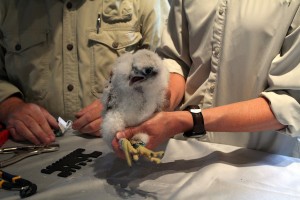
 The banding crew got right to work measuring the size of each bird’s leg to determine whether they were dealing with a male or female. The first one was pronounced to be a female “on the small side”, but in good health overall. She received a black and green ID band with ID number 95/W. On her other leg she got a US Fish and Wildlife band, ID number 1687-01352. As is typical for our bandings, Mike covered the Fish and Wildlife band with colored electrical tape, blue in this case. She was named Jemison by the members of the Rochester Falconcam’s Merchandising team:
Mary Jemison was called “the White Woman of the Genesee.” Kidnapped in Pennsylvania by the Shawnee and French in 1755 at an early age, she was given to the Seneca. Later married to a Delaware brave. She traveled with her baby son, on foot, more than 700 miles to the Genesee river valley. She lived with the Seneca for the rest of her life, gaining respect as as advocate of her adopted nation.
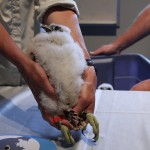 Up next was the bigger of the two eyases. The consensus in the forums was that this one was definitely a girl, and even the DEC folks remarked about how big she was. She got her health check, and other than a few avian lice, she was found to be in excellent condition. Her ID band is black over green, 96/W. Her USFWS band number is 1687-01353, covered with red tape.
We were glad that there was little doubt about this one’s gender. We had invited the students in Mrs. Kim Graffeo’s Kindergarten class from Marion, New York, to name one of the eyases. They did a great job coming up with names for a boy or a girl, but everyone at the Rochester Falconcam really liked the female name they chose: Callidora:
The name comes from two Greek words, “Kallos” (‘beauty’) and Doron (‘gift’). Thus, the name means “Gift of Beauty”. The class thought that was quite fitting since Beauty is their mother’s name.
We agree, Callidora is an excellent name!
Putting the eyases back went as smoothly as getting them out. Archer and Beauty put on another mad flying display, circling and crying, while members of the Rochester Falconcam guarded the backs of the DEC officials as they worked. In short order the eyases were back in the nest box and everyone retreated inside. Another Banding Day success!
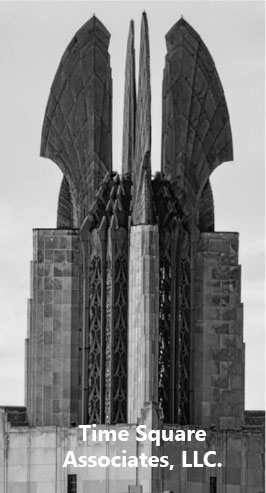
A great deal of work went on behind the scenes so that we could bring the banding event to everyone, and here at Imprints we want to acknowledge the contributions of all those who made today’s event possible. First, we want to extend our heartfelt appreciation to Rich Calabrese and all the folks at the Times Square building who gave us the opportunity to erect the nest box. Without their enthusiasm and cooperation we might not have any falcons to enjoy in Rochester.
We also need to thank our friends at the DEC, especially Barb Loucks, Mike Allen and the newest banding team member, Jenny Landry. Their constant dedication to the health of the Peregrines here in Rochester and throughout New York state is nothing short of amazing. Extra thanks to them too, for their foresight in deciding to place the nest box on Times Square.
Today’s banding event was hosted in the 11th floor offices of Epostmarks. Jason, Janet, and all the folks at Epostmarks not only provided a wonderful venue for the banding, but they generously allow the Rochester Falconcam to be transmitted over their company network, saving us serious cash that we’d otherwise have to spend on Internet access. We’re grateful for their many contributions and support.
Finally, the work of many members of the Rochester Falconcam team went into the banding. June Summers handled the emcee duties. Fal-Kenn Martinez and “Shaky” worked their technical magic to stream the banding live. Jeanne, Aafke, Donna and Ei provided online updates in the Forums. Carol Phillips took still photos from inside that were uploaded to the website, and Jim Pisello grabbed photos and video from the event and coordinated with the media. It was truly a team effort on everyone’s part.
Did you miss the banding? Don’t worry! You can watch the video recap HERE. We’ll also be putting together a photo album, so look for that soon!
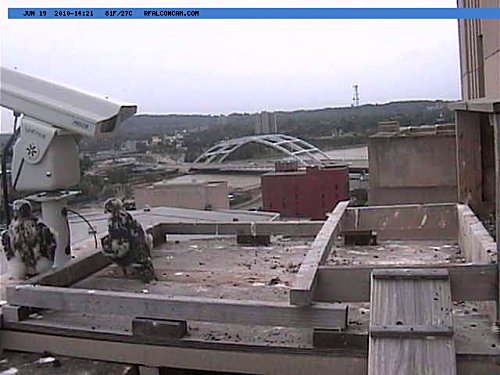
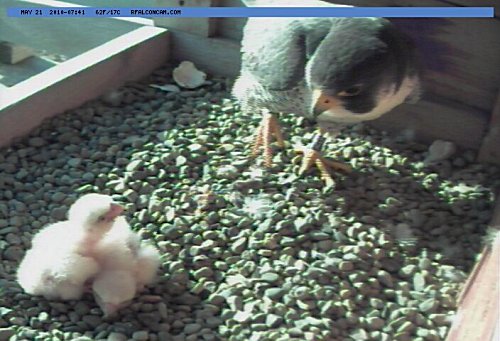
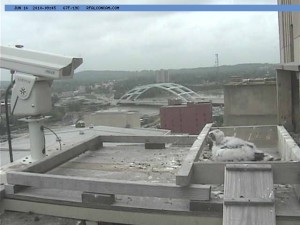 It didn’t take Callidora too long to figure out that only a short hop would take her outside. The nest box rests on a broad plywood platform that’s about 5 feet (1.5m) long and 3 feet (1m) wide, so there’s plenty of room to walk around. It’s also a good spot to get in some flapping practice.